
Effective Date: Immediately, April 20th, 2026.
The comprehensive rules have been updated with the release of this article. Check it out here.
This rule change aims to make copies of activations more intuitive, by properly differentiating cards on the effects stack and their activations themselves. These changes also apply to materializations and bestowments, but there are currently no ways to copy those methods of play.
Before, whenever a player is instructed to copy a card activation on the effects stack, that player would create a copy of the card on the effects stack, as well as an associated activation tied to it. The copy of the card on the effects stack would also copy certain properties such as imbued and remember what costs were paid for the original copy. This is inconsistent with how copies work in other aspects of the game such as the field, where a copied object would not retain properties such as awake/rested, imbued, counters, etc. In addition, a copied card on the effects stack would not retain properties enabled by the specific player, such as empower, and restricted abilities unlocked by the original activating player.
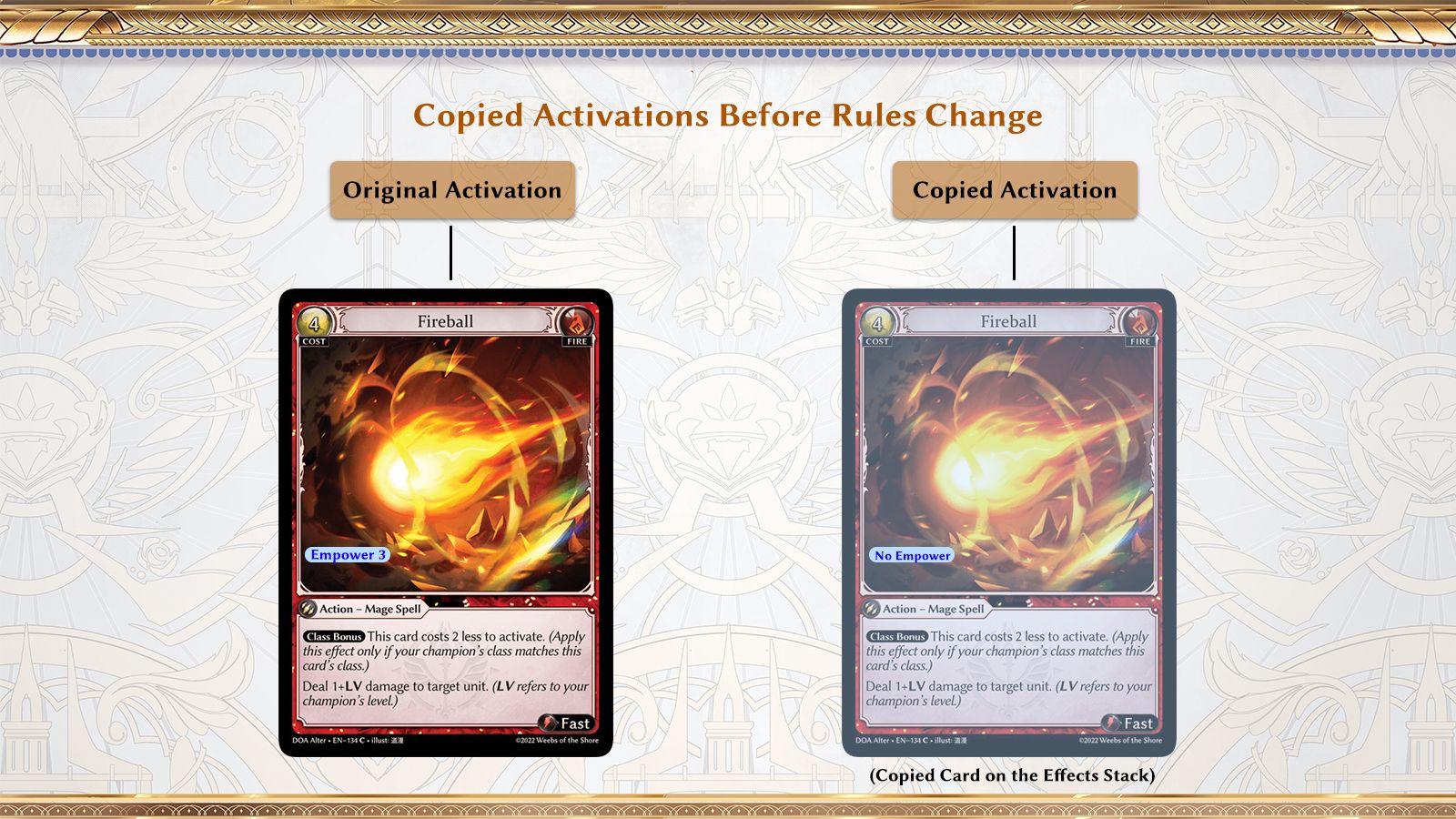
Now, whenever a player is instructed to copy a card activation on the effects stack, that player would only create a copy of the activation tied to the original card on the effects stack. This means there would still only be one card on the effects stack, and two activations associated with it. These activations are essentially instructions to resolve the card, and having two of them means to resolve the card twice. Activations still carry some information such as the controller, and targets. Now, because the copy of the original activation is resolving the original card put onto the effects stack, properties such as imbued and costs paid are no longer copied but effectively replicated in resolution. In addition, player enabled properties are effectively replicated as well.
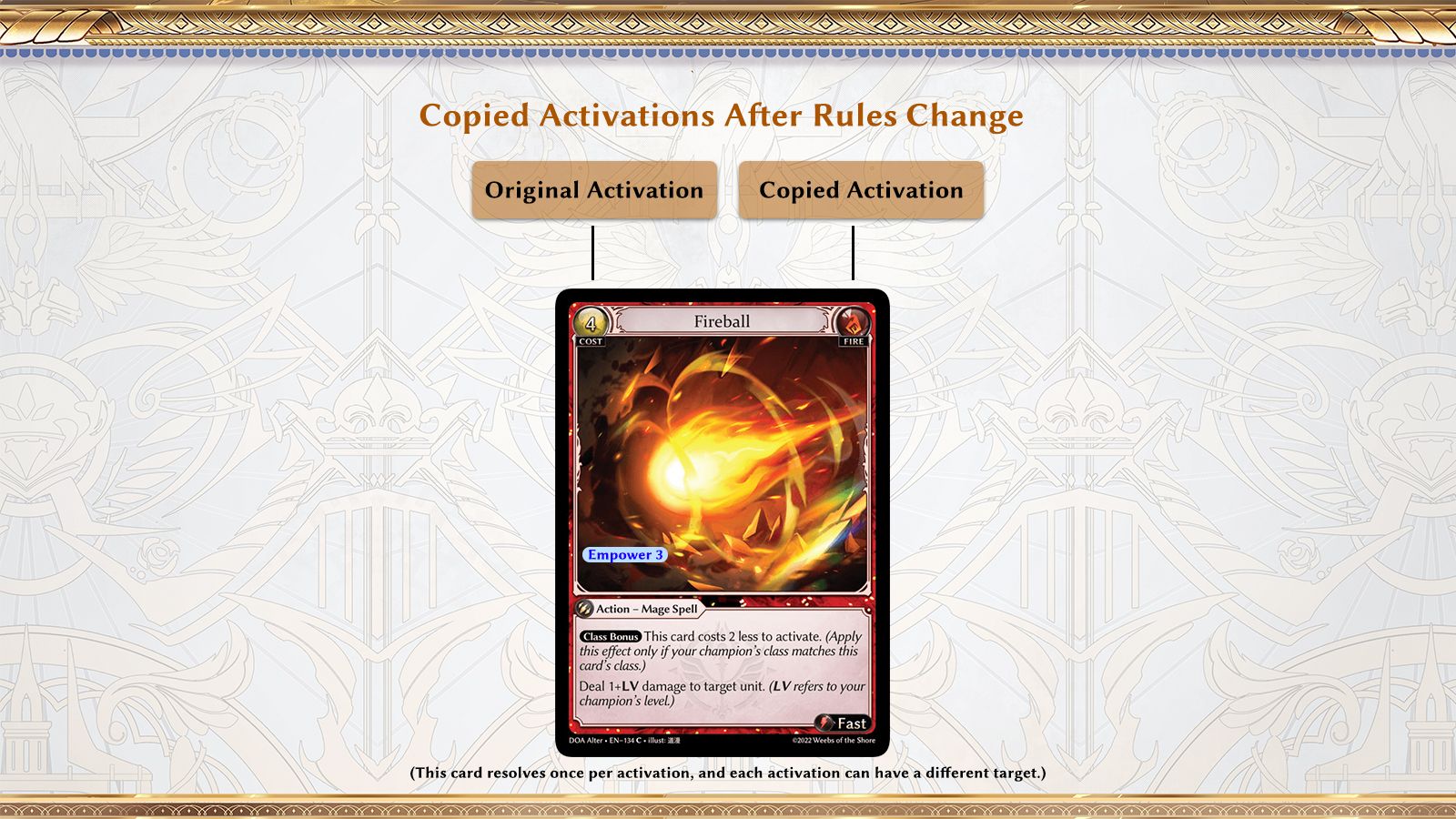
What does this mean?
1.) Player enabled properties such as empower and restricted effects are now replicated in resolution with a copied activation.
2.) Static abilities that apply to cards activated by the controller are properly replicated in resolution with a copied activation. (E.g. Ardus, Floodborne Deacon)
3.) A card does not leave the effects stack until all of its associated activations are removed from the effects stack. This is a state based check, as well as a check upon each resolution.
4.) Negates that move the negated card outside of the effects stack (like Frostbind) will cause copied activations of the associated card to fizzle. This is because the copied activations no longer have a card on the effects stack to reference.
The comprehensive rules have been updated with the release of this article. Check it out here.
This rule change aims to make copies of activations more intuitive, by properly differentiating cards on the effects stack and their activations themselves. These changes also apply to materializations and bestowments, but there are currently no ways to copy those methods of play.
Before, whenever a player is instructed to copy a card activation on the effects stack, that player would create a copy of the card on the effects stack, as well as an associated activation tied to it. The copy of the card on the effects stack would also copy certain properties such as imbued and remember what costs were paid for the original copy. This is inconsistent with how copies work in other aspects of the game such as the field, where a copied object would not retain properties such as awake/rested, imbued, counters, etc. In addition, a copied card on the effects stack would not retain properties enabled by the specific player, such as empower, and restricted abilities unlocked by the original activating player.
Now, whenever a player is instructed to copy a card activation on the effects stack, that player would only create a copy of the activation tied to the original card on the effects stack. This means there would still only be one card on the effects stack, and two activations associated with it. These activations are essentially instructions to resolve the card, and having two of them means to resolve the card twice. Activations still carry some information such as the controller, and targets. Now, because the copy of the original activation is resolving the original card put onto the effects stack, properties such as imbued and costs paid are no longer copied but effectively replicated in resolution. In addition, player enabled properties are effectively replicated as well.
What does this mean?
1.) Player enabled properties such as empower and restricted effects are now replicated in resolution with a copied activation.
2.) Static abilities that apply to cards activated by the controller are properly replicated in resolution with a copied activation. (E.g. Ardus, Floodborne Deacon)
3.) A card does not leave the effects stack until all of its associated activations are removed from the effects stack. This is a state based check, as well as a check upon each resolution.
4.) Negates that move the negated card outside of the effects stack (like Frostbind) will cause copied activations of the associated card to fizzle. This is because the copied activations no longer have a card on the effects stack to reference.