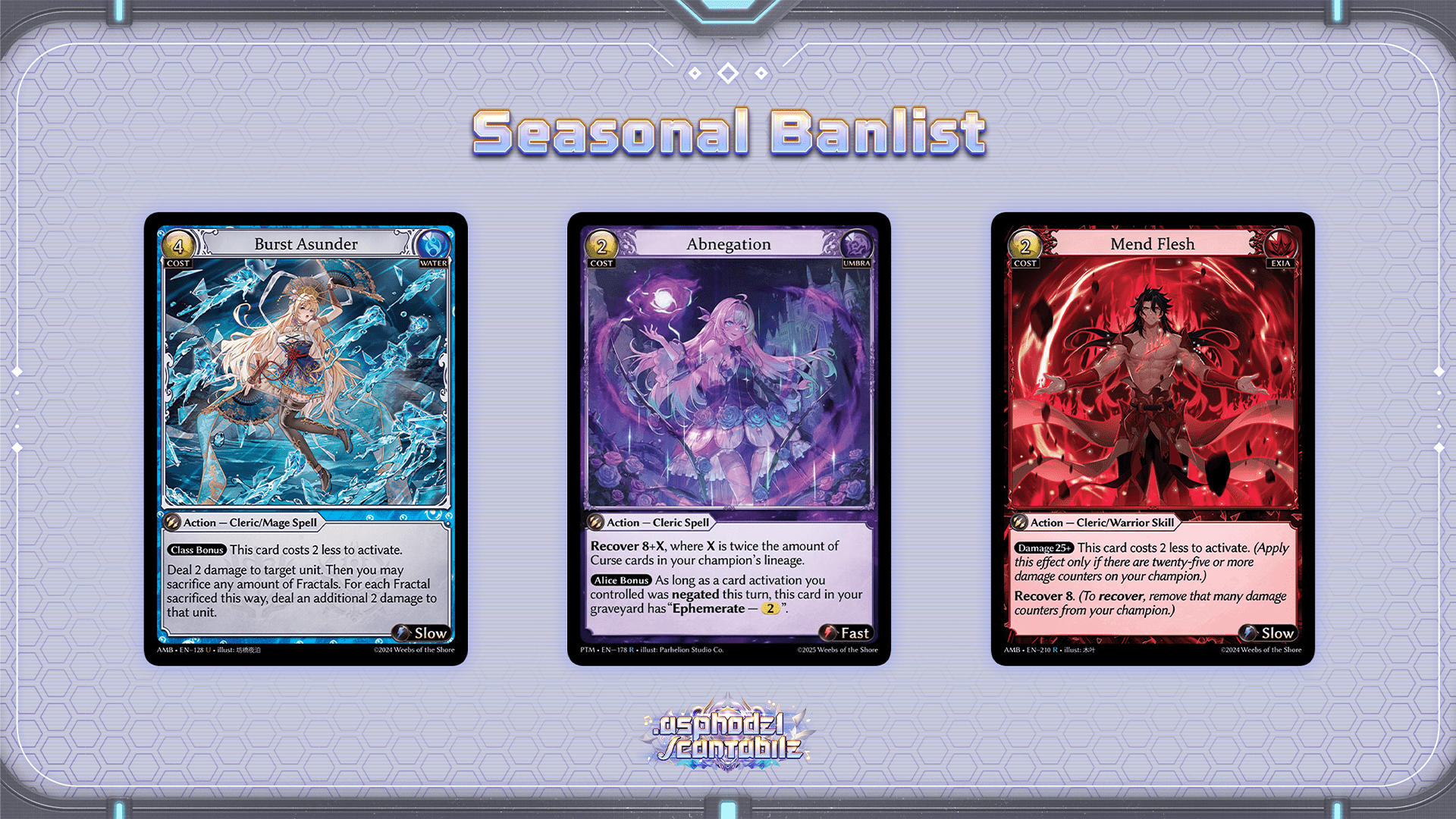
Continuing with the CBL season, the Seasonal Banlist is intended to refresh the metagame and encourage new strategies each season without permanent bans.
November 16th, 2026
With the launch of .asphodel/cantabile, we’re introducing the next Seasonal Banlist for Standard: Burst Asunder, Abnegation, and Mend Flesh.
These changes take effect on Friday, December 11th, 2026, alongside the release of .asphodel/cantabile. This article is an advance reveal; the new seasonal bans are not yet in effect.
The effective date is the set’s release date. The new competitive season begins the following week.
What is the Seasonal Banlist?
The Seasonal Banlist temporarily removes selected cards from Standard, creating opportunities for players to explore different decks and giving established strategies time out of the spotlight.
A few important reminders:
• Temporary by Design: Each seasonal list applies from one main-set release to the next.
• No Consecutive Seasonal Bans: A card cannot be seasonally banned in consecutive seasons
• New Card Protection: Cards become eligible only after three main-set releases have passed since their first printing.
• Flexible List Size: The number of selections can change from season to season.
• Mid-Season Changes: Seasonal bans serve a different purpose from the regular Banned & Restricted process. They let us explore temporary changes to the metagame. Cards that present lasting balance concerns can still be addressed through the regular process.
Seasonal Bans are not intended to replace the regular Banned & Restricted List. Cards that present long-term health concerns will continue to be evaluated through the regular Banned & Restricted process.
Looking Back at the First Seasonal Banlist
The first Seasonal Banlist produced two outcomes we were pleased to see: some strategies stepped out of the metagame, giving players a break from familiar matchups, while others adapted into decks with different strengths and weaknesses.
• Fabled Azurite Fatestone: demonstrated the first outcome. Its seasonal ban effectively removed the strategy built around it from the competitive metagame, giving players a season away from a deck that had become a source of frustration.
While no single criterion being met will automatically result in a Seasonal Ban, the following are some of the primary factors we take into consideration when evaluating if a card should be placed on the Seasonal Banlist.
• Spirit Blade: Ascension: demonstrated the second. Without it, Lorraine shifted away from the Prismatic Edge engine and its influence disruption. Players explored other approaches, including the “Psychomonk” combination of Capacitance X Psycho and Numinous Monk, as well as Ultimate-focused builds. Lorraine remained a competitive option, but the way those decks pursued a win changed.
• Baleful Oblation: prompted a similar adaptation for Ciel. Builds centered on Feu Awakening and Beguiling Coup developed a different set of strengths and vulnerabilities. In particular, spellshroud, graveyard interaction, and recovery-based strategies became more meaningful ways to challenge those decks.
What Remains to Be Seen
The next season will test another important part of the Seasonal Banlist: what happens when these strategies return.
We’re interested to see how they fare against some of the decks that emerged during the .asphodel/paradise season, as well as the new strategies players discover with .asphodel/cantabile. The incoming seasonal bans will also reshape the field, so these returning decks will face a different mix of opponents. How players adapt will help us evaluate the full cycle of a seasonal ban.
Why These Cards?
Burst Asunder
Fractal decks were the most represented strategy during the .asphodel/paradise season, although their lead over other decks was modest. The strategy has remained largely familiar, with recent improvements making it more efficient, and player frustration with the matchup has been building over time.
Fractals were already strong when we introduced the first Seasonal Banlist, and they have continued to be a prominent part of the competitive environment. For .asphodel/cantabile, we want to give players a break from that familiar game plan and create room for other decks to develop.
Burst Asunder is our selection for that change. Removing this payoff for a season asks Fractal players to reconsider how they convert their board into a win, while giving their opponents a different matchup to prepare for.
Abnegation and Mend Flesh
With Abnegation and Mend Flesh, we want to improve aggressive decks’ position against Umbra Ciel and Exia Jin, respectively, during the .asphodel/cantabile season.
These recovery tools help those decks withstand early pressure and maintain favorable matchups against aggro while still pursuing their level-three payoffs. Removing them for a season gives aggressive decks more opportunity to turn early pressure into a win, while encouraging Umbra Ciel and Exia Jin players to adapt how they defend themselves.
We believe this shift will make for an interesting metagame, creating more room for aggressive strategies alongside returning decks and the new possibilities introduced by .asphodel/cantabile.
When Do These Changes Take Effect?
Burst Asunder, Abnegation, and Mend Flesh become seasonally banned on December 11th, 2026, alongside the release of .asphodel/cantabile.
At that point, Baleful Oblation, Fabled Azurite Fatestone, and Spirit Blade: Ascension leave the Seasonal Banlist.
We look forward to seeing how players revisit returning strategies, adapt established decks, and discover new possibilities in .asphodel/cantabile.
Our regular Banned & Restricted update will also be published ahead of the set’s release. That announcement will include the complete legality update, including these seasonal bans. All changes announced in that update will take effect on December 11th, 2026, alongside the release of .asphodel/cantabile.